We film in front of a live audience, and I was a theater actor before I got into television, so I like that.
Leave a movie audience inspired, and they will want to ingrain that movie into their lives with the toys, branded food products, soundtracks, and clothing they buy.
I'm looking for the truth. The audience doesn't come to see you, they come to see themselves.
As far as doing TV, I do think there's a big audience out there that could enjoy classical music, but they don't know how to find it, and sometimes by doing different things... crossover things probably make up about 5% of what I do.
I find theater terrifying. There are no do-overs, you know? It's all happening live. You need to be in it 100 percent at any given moment, and the audience is right there. I'm really intimidated by theater, but it is my first true love. I love theater. I love that anxiety.
And that's another reason to make this movie: We can put plays on film now, at a relatively small cost, and they will reach an audience they would never have reached otherwise.
All of the material for 'The Fine Line' was created via improvisation with my partner, but not in front of an audience. We'd continue to refine it in front of an audience based on their responses until it was set and scripted.
I love movies that are just straight-up exploitation, but the ones that endure and the ones that last are the ones where the filmmakers put in that extra level of thought; after 25 years you put them on in front of an audience, and they'll respond to it and enjoy it.
I know I am always pumped, as an audience member, to go and see a Western.
Both me and Edgar are firm believers in never underestimating or talking down to an audience, and giving an audience something to do, to give them something which is entirely up to them to enter into the film and find these hidden things and whatever.
We kept a broad audience, and we didn't make fun of people who had necessarily made mistakes in their life and burned them to the ground. We made fun of a commercial or a movie or ourselves.
Tracking action without cutting is the least jarring method of placing the audience into a real-time experience where they are the ones making the subtle choices of where and when to look.
Most actors want the audience to like them, and that leads to bad acting.
Own every note I sing and sell it. Make a connection to the audience. That's what it comes down to, you know?
I think the audience for Limp Bizkit is probably not going to be particularly interested in what we're doing. I don't think they'll find much that satisfies them in what we do.
It's easier not to make a particular joke in case it offends. But every joke will offend someone, and I've always believed that the audience is bigger than one person. The danger is that things will become bland.
I want an audience that's passionate, that can be engaged.
When I give talks like the one I'm going to give at the Changing Advertising Summit, one of the points I often make to the audience is that I'm not one of those speakers who stands in front of the audience and pontificates - everything I talk about I'm actually doing myself. I'm living it.
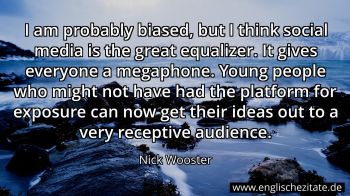
I am probably biased, but I think social media is the great equalizer. It gives everyone a megaphone. Young people who might not have had the platform for exposure can now get their ideas out to a very receptive audience.
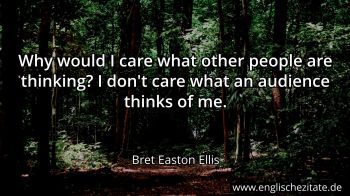
Why would I care what other people are thinking? I don't care what an audience thinks of me.
I performed in public for the first time at three years old. I remember it like it was yesterday. It was on a big stage. There were probably three or four hundred people in the audience. We were doing this dance, this Kermit the Frog routine, all of us in our little green leotards.
Every inch of my writing career has been influenced by my screenwriting education. I was lucky enough to go to film school at USC, and I got a crash course in how to tell a story efficiently. I learned structure, pace, my style, how to know your audience, and most importantly, how to take criticism and edits properly.
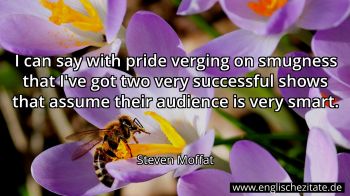
I can say with pride verging on smugness that I've got two very successful shows that assume their audience is very smart.
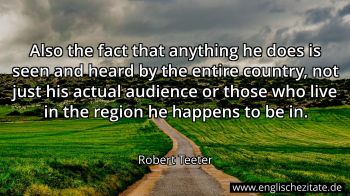
Also the fact that anything he does is seen and heard by the entire country, not just his actual audience or those who live in the region he happens to be in.
If I can get the audience to connect with the characters emotionally - and they love who they are, they love the larger-than-life situation that they're in, but most of all get the audience invested in the characters - then I always feel like I can sort of put them in the most outrageous circumstances, and the audience is okay to go with that.
I think that by ignoring the show you're ignoring the audience who put you there.
I know it's popular to say this because she's the woman of the moment, but Halle Berry. Not only does she have obvious audience appeal and star quality, but she's a damn good actress too.
I would really, really, really like to be a legend like Madonna. Madonna knows what to do next, and when she's performing, the audience is just in awe of her.
That's probably when I get the most angry at American movies, when they just so cynically manipulate the audience without even trying to give a good story.
Most actors spend a lot of time training themselves to be an actor. And I kind of didn't do that. I just started doin' it in front of an audience and had to deliver.
I don't think a movie today that captured all the things that we did in the seventies could come close, because it's like asking to recreate the seventies and the audience sensibilities and that's impossible.
To me, there was nothing greater than to play for an audience and to entertain people and that has stayed with me all these years.
The audience wants to be attracted not by the critics, but by a great story. You must deliver to the audience emotion - and when I say emotion, I mean suspense, drama, love.
I love doing theater so much - being in front of an audience and seeing how a character grows and develops with every performance.
Watching President Obama apologize last week for America's arrogance - before a French audience that owes its freedom to the sacrifices of Americans - helped convince me that he has a deep-seated antipathy toward American values and traditions.
I have to have the 'umph.' I've got to feel it, because if it's not getting through to me, the audience sure as hell aren't going to feel it either.