I enjoy both comedy and drama, and have had memorable experiences in both film and T.V.
When you make a drama, you spend all day beating a guy to death with a hammer, or what have you. Or, you have to take a bite out of somebody's face. On the other hand, with a comedy, you yell at Billy Crystal for an hour, and you go home.
If you're on a network show, it's either some wacky sitcom or a drama where you're servicing a procedure.
My first year of university, I ran around and signed up for these clubs, and I noticed they were all drama clubs: really lame, artsy things.
Acted drama requires surrender of one's self, sympathetic absorption in the play as it develops.
I think you learn a lot about a country from its art. To me, it's part of the drama of life. It teaches you that there are places, moments and incidents in other cultures that genuinely have a life of their own.
I'm a right pain in the hole for my agent. I won't take certain parts if I think they're offensive or banal. For instance, I won't do a film if I think it's full of violence for violence's sake, or a television drama if I don't think it's intelligent writing.
People talk worse about people than they talk good about people, because a lot of people like drama.
The most difficult thing to do is drama.
A lot of people give actors credit when they gain weight for a role in a drama when they win an Oscar, but when you're doing a sitcom, people don't give you a lot of credit, because you've got to keep your weight on for five or six years if it's successful.
When I first started out in the industry, I was 12 or whatever, and I wanted to be on something so bad, and I didn't know what I was going to be on. At the time, I was in school, and I was working on drama and theatrical stuff, so I never thought that I'd end up going to comedy.
Sometimes I'll turn the channel and there's the movie and I can honestly say that those last few minutes always fascinate me. It's one of the rare instances when image, music, and drama work effectively.
The dirty little secret of foreign correspondents is that 90 per cent of it is showing up. If you can find a way to get there, the story, the reporting, it's the easiest you'll ever do. 'Cause the drama's everywhere.
I was always a drama queen. I remember playing in the kitchen, trying to get my mom to think I was dead and call the police. When she didn't, I would cry. I was always theatrical. I don't think any of my relatives are surprised.
When I left school I went to Australia for a year and worked in the drama department of a school in Perth.
A handful of works in history have had a direct impact on social policy: one or two works of Dickens, some of Zola, 'Uncle Tom's Cabin' and, in modern drama, Larry Kramer's 'The Normal Heart.'
I was lucky to get into drama school and become a professional actor. No-one ever mentioned the colour of my skin. It's only when I came out of RADA - the Royal Academy of Dramatic Art - that I suddenly realised people started to refer to me as a black actor.
Comedy can be harder because if you aren't making the audience laugh, they're going to turn on you quicker. They'll go along with mediocre drama more than they'll go along with mediocre comedy.
I loved music, acting, and drama, but these weren't something I pursued until I was 19.
My dad said, 'Go to college and take whatever you want.' So, I went to the University of Miami. When I got up to the line at registration, I saw that you had to take math and history. I said, 'There's no way I'm taking math and history.' And right next to it was the line for the drama department.
Michigan is two radically different places - the North and the South which makes for good drama and contrast.
Overall, the anarchy was the most creative of all periods of Japanese culture for in it there appeared the greatest landscape painting, the culmination of the skill of landscape gardening and the arts of flower arrangement, and the No drama.
I was never part of that cliquey girl drama. Most of my friends were guys growing up, so I was never part of that whole toxic energy. It seemed like way too much hassle.
I wrote a play at drama school, which was a dark comedy - people laughed and cried. And then my script of one of the shows was picked up by a comedy sketch company... so then I had to write comedy.
First play I ever did was 'Footloose.' I played the part of Willard when I was 16. I think I wore my drama teacher's jeans and her belt - that's how small I was. I know a lot of Willard's back story from the musical that's not explored in the film. Like he's got this whole relationship with his mama, and he sings this song 'Mama Says.'
I try to bring the audience's own drama - tears and laughter they know about - to them.
Don't Make Assumptions. Find the courage to ask questions and to express what you really want. Communicate with others as clearly as you can to avoid misunderstandings, sadness and drama. With just this one agreement, you can completely transform your life.
'Scandal' is great because it's intriguing and sexy, and it has a lot of play with secondary characters in situations, lots of drama.
At its core, 'Heroes' is an ensemble character drama with genre elements.
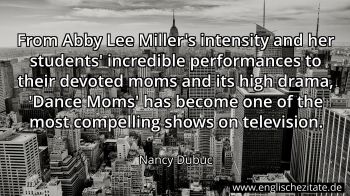
From Abby Lee Miller's intensity and her students' incredible performances to their devoted moms and its high drama, 'Dance Moms' has become one of the most compelling shows on television.
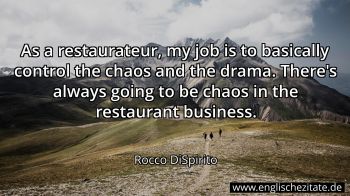
As a restaurateur, my job is to basically control the chaos and the drama. There's always going to be chaos in the restaurant business.
I'm particularly drawn to actors in their own little drama. I find it's that area I'm very alive to. And I don't encounter it that often. You have to be far from civilization, you have to be far from New York or London to find people who do that.
At the heart of drama is conflict.
When I heard that 'Dracula' was being made into a series by NBC and Carnival, I couldn't resist. I knew they would do something interesting with it. A period drama with a supernatural twist seemed like a whole lot of fun.
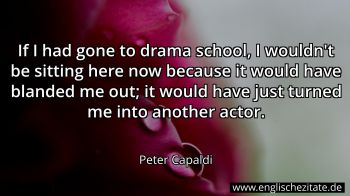
If I had gone to drama school, I wouldn't be sitting here now because it would have blanded me out; it would have just turned me into another actor.
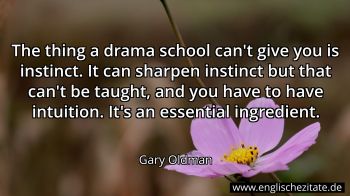
The thing a drama school can't give you is instinct. It can sharpen instinct but that can't be taught, and you have to have intuition. It's an essential ingredient.