The villain drives the plot.
So much of the literature we had to read for high school English class was filled with victimized, tragic, symbolic women who spurred the plot forward with their inevitable shunning/death/shunning-followed-by-pregnancy-followed-by-death timelines.
The one thing I would like more credit for is being part of a movement which involves recognising the importance of plot and asserting that books of literary worth could be written that had plots.
I shy away from plot structure that depends on the characters behaving in ways that are going to eventually be explained by their childhood, or by some recent trauma or event. People are incredibly complicated. Who knows why they are the way they are?
I'm not good at narrative; I'm really a gag writer, and that comes from being in the newspaper comic strip world for a while in college. What I do is I just write tons of jokes, then I sort them out in terms of quality and then pick the best of the jokes and then try to form them into a plot. If I get a good theme going, I feel lucky.
Soils and national characters differ, but fairy tales are the same in plot and incidents, if not in treatment.
I'm not like a Sears Catalog of ideas. I don't have that many ideas. I've more or less written them over the years. Usually, I come up with a situation or a character, and it rattles around in my head until the story or the plot emerges.
A good script is like a work of art in itself. I've read hundreds of scripts, and good ones are very rare. If the writer has something to say, and a voice, and a plot that matches character, and an emotional trajectory that works, then I'd be an idiot to fool around with it. It's just that few scripts ever are like that.
'Harry Potter' shouldn't be children's first experience with suspense and plot turns.
If you can remove a female character from your plot and replace her with a sexy lamp and your story still works, you're a hack.
Hydrogen peroxide-based bombs were used in the London bombings in 2005; in al Qaeda's foiled plot to attack subways in New York City in 2009 and also in the ISIS-directed Paris attacks in 2015 and the ISIS-directed attacks in Brussels a year later.
Character is primary. What happens as far as plot and events is not as intriguing to me as what's happening inside this particular person.
In comics, there are depths that don't reveal themselves immediately, and the stuff that you might consider anal about 'Watching the Watchmen' - like the notes where I plot the rotation of a perfume bottle through the air - might not be particularly obvious to anyone who reads it.
'Rozabal' was theological while 'Chanakya' is political. Unlike 'Rozabal,' which was about research, the aim of 'Chanakya' is plot, plot, plot, which carries the character. The common DNA, of course, is history.
If I had a plot that was all set in advance, why would I want go through the agony of writing the novel? A novel is a kind of exploration and discovery, for me at any rate.
The audience today has heard every joke. They know every plot. They know where you're going before you even start. That's a tough audience to surprise, and a tough audience to write for. It's much more competitive now, because the audience is so much more - I want to say 'sophisticated.'
I work on one book at a time. And yes, I am immersed. Six days a week for four to six hours a day. In between books, I stop writing for as much as two to three months, but during that time, I do research and think, plot and plan the book.
My goal is to write books that are quality books with very real characters and a gripping plot.
I wrote four novels under the name Amy Silver. The first one was commissioned, and I was given basically the whole plot and the characters. They told me what to do, and I went straight away and did it. After that, I continued, and I was coming up with more my own ideas, although they did steer me.
In a very literal way, of course, Shakespeare did change the course of history: when it didn't fit the plot he had in mind, he simply rewrote it. His English histories play fast and loose with chronology and fact to achieve the desired dramatic effect, re-ordering history even as it was then understood.
If somebody from the past doesn't rise up from the grave and start talking to me, I haven't got a book. I have to hear that voice, the voice of the narrator. How she sounds will tell me who she is, and who she is will tell me how she will act - and that starts the plot in motion.
I earned my Ph.D. in philosophy, and one of my specializations was the logic and mathematics of game theory. I've also got a degree in drama, so I know about stories, characterizations, plot arcs, and the like. Lots of game designers can do one or the other: I've got the skills for both.
I'm very good at plot.
Social media give me the privilege of learning about more people than I could meet in my whole life. Taken together, the Internet reads like the grandest character-driven novel humanity has ever known. Not much plot, though.
Kajol as Vasundhara is a tough cookie. Raghu and her world collides, and they have different ideologies. The plot revolves around their core beliefs and their disagreement with each other.
I hate SF books that think all you need to make a book is cool technology and mind-bending ideas without a decent plot or characters. And I hate when fantasy books are allowed to ramble off into five hundred page diatribes which don't advance the story one bit.
I've always figured the only way I could finish a book and get a plot was just to keep making it longer and longer until something happens - you know, until it finds its own plot - because you can't outline and then fit the thing into it. I suppose it's a slow way of working.
I sit in my room at my desk, looking out the window to the yard and waiting for a plot to come to me, to rise slowly in my mind.
Part of the reason why so many actors lose the plot when they go over to America is that they become part of an industry, so that's why they don't want to play weak, bad or vulnerable guys - because that's not sellable; that diminishes their profit margin.
I always write on unlined typing paper and write the first draft in longhand, using cheap Bic pens. I try to write about four pages a day, which usually yields a first draft in six months. I don't plot ahead of time, so I'm flying by the seat of my pants for the first draft.
I've never really found inspiration for story ideas in the news, but I'd say it certainly affects our lives in so many ways. I would say that certainly the stories of the day appear in the work - I just have never gone so far as to say, well, this particular event could influence a plot of an entire book.
If something is crucial to the plot, then I'd better be sure I've got my facts straight. Readers of crime novels are smart and savvy, and they'll waste no time letting me know if there's a hole in my plot.
I don't plot my books rigidly, follow a preconceived structure. A novel mustn't be a closed system - it's a quest.
In America, if you are a landowner, you own the minerals vertically underneath your plot. So if there is shale, you get a share.
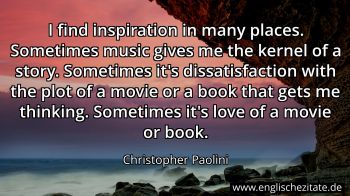
I find inspiration in many places. Sometimes music gives me the kernel of a story. Sometimes it's dissatisfaction with the plot of a movie or a book that gets me thinking. Sometimes it's love of a movie or book.
I think too often in films, people think endings are a summation of plot, and I don't like that. Because once you know where you're going as an audience member, then it's like a video game. You're just waiting for them to get through the levels and beat the bad guy. And I just think that's boring.