I always wanted to play a cowboy. I just didn't get to do it the way I thought I would.
Motherhood definitely took the focus off of my work. And I didn't mind. I had a few panics when I thought that if I wanted to work I couldn't get a job anymore and then I would get one once in a while and it would make me feel better.
I was raised in Kenya, and I always wanted to be an actor from when I was really, really little, but the first time I thought it was something that I could make a career of was when I watched 'The Color Purple.' I think I was nine, maybe, and I saw people that looked like me - Whoopi Goldberg and Oprah.
When 'Nevermind' came out, my roommate had the CD. At first, I actually thought, 'This is too polished and commercial.' It was a little off-putting. But then I was like, 'This is the best music ever.' It felt so close to what I wanted to do.
When we were doing 'Sports Night' and 'West Wing' at the same time, I thought I was the luckiest guy in the world because my two interests were politics and sports.
I thought I was going to be a horror story writer. My influences were horror writers, like Rich Matheson, Ray Bradbury and Bram Stoker.
When I went to drama school, I thought that everybody would think I was only there because my dad was on TV.
I always thought of myself as James Bond.
Of course, every job I ever had I thought I was born for.
We have nine ships and in the next two years will have ten, eleven and twelve. So things are going very nicely and all because of that program that people thought was mindless and so forth.
In today's world, America's soft power is commonly thought to reside in the global popularity of Hollywood movies, Coca-Cola, McDonald's and Starbucks.
I always thought of myself as a good old South Dakota boy who grew up here on the prairie.
There's a lot of stuff I thought I'd do in the world, but I never thought I'd have a street named after me in my hometown. It's a great feeling.
Because Bin Laden's culture doesn't permit the worship of images, they understand how powerful images are. We wouldn't have thought of creating a visual bomb. In a way, he's chopped down two iconic buildings, and used our very truth imagery, to express himself. It's fascinating... I mean, dreadful.
As a boy soprano in the high school choir, I later sang a solo during the carol service at Canterbury Cathedral, but I was too young to secure the Freddy Eynsford-Hill role in our production of 'My Fair Lady' - and far too timid to have thought to audition for it.
I've always thought Shawn Michaels's story is fascinating.
When I left high school - I was younger than my classmates, just 17 - I knew I wanted to be an actress, but I thought, 'When I go to college, I'd rather study something else.'
We had seen the way the print industry had been disrupted; we'd seen how the audio industry got disrupted, so it just seemed like a natural progression that video was next. We thought we were late to the game in 2003.
There are designers who say, 'Oh! I see wallpaper and blue carpet.' I usually start by knocking down walls. 'You thought you just needed some new drapes? Well, guess what: That wall's gotta go.'
When I was a teenager, I had pimples - oh, God, every time someone looked at my face I thought they were looking at my pimples. I put mud on my face to dry them out, and it worked.
I never really thought about being a role model. I started really young, so at 10 years old, I was still very much the person who needed role models. I wasn't really prepared to be one, but it's always something that I've taken very seriously.
I can remember being at Sandringham, for the first time, at Christmas. And I was worried what to give the Queen as her Christmas present. I was thinking, 'Gosh, what should I give her?'. I thought, 'I'll make her something.' Which could have gone horribly wrong. But I decided to make my granny's recipe of chutney.
When President Ronald Reagan asked me a stupid question once, I called him an idiot in public! I thought I was going to be arrested, but he laughed and appreciated me.
My parents always knew that I loved music. They just didn't think I'd try to make it a career. They thought I'd be a painter or an art teacher or something like that.
Of all Americans who have appeared on the nation's postage stamps, Ayn Rand is probably the only one to have thought that the United States government has no business delivering mail.
When I was 26, I got offered the Connecticut job, but the ABA started, and I thought I could still play.
Usually, whenever my mom would come over I would try and put on music that I thought she would like just to make her feel more at ease.
When I started out as a novelist, I thought I was going to be a private-eye writer. That was my intent, and that's what I studied, I mean, scholarly.
I don't watch television, but I saw 'The Office' by accident. I thought it was so sophisticated, the Victorian love story, and so bold. We'd do anything, all of us, to not work in that environment, and then I'm sitting there watching hours of it.
I had written a tune called 'Shake, Rattle and Roll,' but the white stations refused to play it - they thought it was low-class black music. We thought what we needed was a new name. But a white disc jockey named Alan Freed laid on it, and he thought up the name 'rock n' roll.'
I'd somehow always thought of the classics of literature as something apart from me, something to do with academic life and not something you enjoyed.
I was on the cusp - or thought I was on the cusp - of celebrity, the result of starring as an adorable curly-haired alien in the miniseries 'V' on NBC. 'V' was a hit, and then got green-lit as a series. During the hiatus, the only job I auditioned for that fit my schedule was 'Nightmare on Elm Street.' That's the real reason I said yes.
I didn't really hear any other music other than what my dad was working on until I was 12. My recollection of hearing other music was that I liked some things that I heard but I always thought, 'Where's the rest of it?' It didn't have the same amount of detail or instrumentation or imagination in the arrangements.
Several years ago, when I was about to start a novel, I thought I might get some mileage out of the idea of a civilization in which people somehow felt - that is, they shared - all the pain and all the pleasure they caused one another.
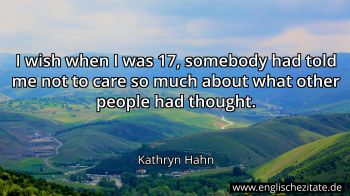
I wish when I was 17, somebody had told me not to care so much about what other people had thought.
There were authors I read as an adult who completely inspired me. But when I was a teenager, I got to hang out with Tom Stoppard for a bit. My mum was his wife's secretary. He was obviously super smart, but he was also approachable and normal. I think he was the first person I'd ever met who I'd thought, 'Oh, I see. There's a living in this.'