Whether you do stand-up comedy or write a story, you have a duty to deliver. As a comedian, you walk out on stage, and you have a minute to hook them, or they'll start booing. As a writer, it's very similar. A reader doesn't have time to say, 'I'll give him 50 pages, as it's not very good yet, but I hope it'll get better.'
The architecture of a story can be a little bit different if it's a true story.
You want a story? Read 'Gone With the Wind'. These aren't stories. They're joke books. The whole thing of a beginning, a middle and an end has been done to death.
Let me tell you a story about when I was growing up in Spain. Many Sundays, we would invite 30, 40, 50 people to the countryside, and my father would make a big paella. He put me in charge of the fire and the 'stove' - the rocks that hold the pan. But he wouldn't let me cook. I got so unbelievably upset.
I need to keep my story count high. I'm trying to get as many stories in my hour as is humanly possible. We're telling more stories in our hour than any national newscast has in the history of this business, I think.
There comes a point in every story where you have got a reservoir of knowledge, and you are then really just adding the substantial new facts to your understanding of it. That is the easiest situation, because you can call on that reservoir, but when you get a sudden story out of nowhere, like ebola, you don't have a reservoir of knowledge.
Children will go with any story as long as it's good, but white adults sometimes think that if a black child's on the cover, it is perhaps not for them.
I still like the relationship part of any story. You don't want your character to figure everything out and then at the end of the day, go home and eat soup from a can by herself.
'Manhattan Love Story' has a very special place in my heart for many reasons. We were very sad to see it go. It brought me to New York, and there's nothing better than getting to go to work and fall for Analeigh Tipton every day.
I now find magic in the mundane. I'm also more creative - better able to look beyond the obvious and come up with new story angles.
There's always a slight tension when you sell a book to Hollywood, especially a nonfiction book. The author wants his story told intact; the nonfiction author wants it told accurately.
As you follow the escapades or the journey of the hero through a story, it evokes some kind of emotion in the viewers. The director's job is to make sure that the audience goes through the journey and has an emotional reaction.
Normally when I'm sent a script I'll read it through to see how it hangs as a story and then I'll go back and read it through again and look at the character.
I wanted to connect a modern story with a myth that I had read.
I'm not going to name some of my colleagues who are very well-known for their television presentation, but they wouldn't know new information or how to report a story if it came up and bit them.
Most magazines have become wallpaper, they're all the same, all the same celebrities. It's really an abysmal time in American journalism right now. But occasionally one story or two will pop out.
For all the import and message of 'The Iliad,' it's ultimately a story that's meant to be heard, and the person hearing 'The Iliad' determines what it means.
It's the only way I really know how to tell the story is to be able to kind of live through the characters. So when I find something that resonates with me, it's usually because it cuts to something very real inside of me; something that I've gone through or experienced.
I like to compare the holiday season with the way a child listens to a favorite story. The pleasure is in the familiar way the story begins, the anticipation of familiar turns it takes, the familiar moments of suspense, and the familiar climax and ending.
'Can You See' is a beautiful song that follows a story of the star. It's a very inspirational song.
The power of story and the power of a well-crafted film or television show is really all you need to speak to people. I think Hollywood is sort of catching up to that.
I've read a lot of really great characters in some really crappy stories, where I said, like, 'Boy I could shine here, but the story sucks.' I don't want to be part of that.
The desire to move into a bigger house, to avoid living AIDS daily, and a dream to be accepted by a community and school, became possible and a reality with a movie about my life, The Ryan White Story.
Honestly, I expected to get a cold reception because of my subject matter. But when editors took a look at the story I had to tell, and saw that this was not a parochial story at all, they really warmed to it.
Part of this whole Sleater-Kinney 2.0 is breaking the rules. We wanted to tell our story... we feel like we need to stand up for ourselves.
I had one of those defining moments in the fourth grade when my teacher said the story I wrote was the best in the class, and therefore I would be going Young Authors Conference where I'd get to hang out with authors all day.
Although I sometimes enjoy writing from an adult's perspective, I feel dedicated to the coming of age story - that part of a young person's life where he must make a decision that will change his life forever. I still remember what it's like to be twelve years old.
An abiding preoccupation for me is how much of our lives are invisible and unknown by other people, like the Chekhov story 'The Lady With the Little Dog.'
You see so many movies... the younger people who are coming from MTV or who are coming from commercials and there's no sense of film grammar. There's no real sense of how to tell a story visually. It's just cut, cut, cut, cut, cut, you know, which is pretty easy.
'Years of Living Dangerously' is a wonderful opportunity to reach a lot of people with the story and importance of climate change in our lives; in recent history, there's no bigger threat to the quality of human life than what is taking place right now in respect of climate change.
The arc of the American story is long, it is bumpy and uncertain, but it always bends toward a more perfect union.
When you work with somebody else, you automatically get a mixed voice. You hope it will benefit the story. But you don't know what the result will be.
A story has been thought through to the end when it has taken the worst possible turn.
Any film I've made, I've only really begun to understand in the cutting room. That's when the story shows itself to you, like a wreck coming out of the sea.
For years, I sort of would try to write a story that somehow fit the title. And I don't think it happened for maybe another four years that I actually thought of a story, the plot of a story that corresponded to that phrase.
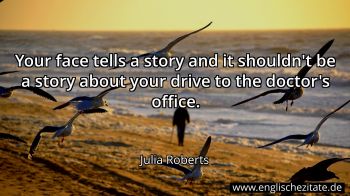
Your face tells a story and it shouldn't be a story about your drive to the doctor's office.