Shakespeare has no answers for us at all.
I think film should raise questions, not give answers. I think film should challenge people to reflect, debate and get by themselves to the answer that fits them.
I learned quickly, as I tell my graduate students now, there are no answers in the back of the book when the equipment doesn't work or the measurements look strange.
The South: What is this place? What's different about it? Is it different anymore? Good questions. Old ones, too. People have been asking them for decades. Some of us even make our living by asking them, but we still don't agree about the answers.
Scare answers to scare, and force begets force, until at length it comes to be seen that we are racing one against another after a phantom security which continually vanishes as we approach.
The only interesting answers are those that destroy the questions.
Rarely does an interviewer ask questions you did not expect. I have given a lot of interviews, and I have concluded that the questions always look alike. I could always give the same answers.
I don't try to be completely calculating in everything I say and do, but there's no way I'm going to talk. There's no reason to. And that's why I'm such a boring interview, because I don't go for the shock value, or smartass answers.
I don't practise any religion but I am deeply interested in the answers that mankind has come up with to explain the human situation.
I don't go to church regular. But I pray for answers to my problems.
The questions don't do the damage. Only the answers do.
We don't know all the answers. If we knew all the answers we'd be bored, wouldn't we? We keep looking, searching, trying to get more knowledge.
There were questions I didn't have the answers to, and I was trying to figure it out. I remember staying up until 4 A.M. reading the Bible and praying.
It is wise to direct your anger towards problems - not people; to focus your energies on answers - not excuses.
I don't think women hold all the answers, but with their skills, their strengths, we can get to a better place.
When you're a queer person put in the spotlight, you're supposed to have all the answers.
Though there might not be any easy answers to the problem of poverty, its most compelling scribes do not resign themselves to representation solely for the sake of those age-old verities of truth and beauty.
I don't see myself being special; I just see myself having more responsibilities than the next man. People look to me to do things for them, to have answers.
The job is to ask questions-it always was-and to ask them as inexorably as I can. And to face the absence of precise answers with a certain humility.
The upshot here is that Gil Scott-Heron is still a warrior, even if the front lines have moved. He's made a record not without hope but which doesn't come with any easy or comforting answers. In that way, the man is clearly still committed to speaking the truth.
My books deliberately provide no answers or messages. I'm drilled in the habit of objectivity and also aware that the steady drip of fiction has more power than facts to shape opinion, so I handle it with caution.
Whatever you think of de Sade, he was a complex figure and we should not look for easy answers with him. He was, strangely perhaps, against the death penalty, and he was never put in prison for murders or anything like that.
Before you start some work, always ask yourself three questions - Why am I doing it, What the results might be and Will I be successful. Only when you think deeply and find satisfactory answers to these questions, go ahead.
We'd like to have immediate answers to all of our questions. I think medicine in particular. I found it frustrating as a physician sometimes to not be able to tell someone exactly why something was happening to them. There are still so many mysteries in medicine.
Even if it's a national issue, the federal government cannot provide all the answers.
Questions are a burden to others; answers are a prison for oneself.
Successful people ask better questions, and as a result, they get better answers.
I don't write about things that I have the answers to or things that are very close to home. It just wouldn't be any adventure. It wouldn't have any vitality.
We can never know for certain where our prayers are likely to go, nor from whom the answers will come. Just when we think we are at our nearest to God, we could be assisting the Devil.
There are no easy answers, but there are simple answers. We must have the courage to do what we know is morally right.
Conversely, beware the man who does nothing but ask you questions about yourself and offers no information about himself. Not only is he keeping you at bay, he is probably not listening to your answers.
I like to write about things about which I have no answers, questions that trouble me. These things trouble me.
The wise man doesn't give the right answers, he poses the right questions.
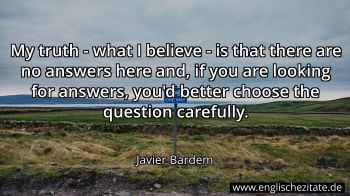
My truth - what I believe - is that there are no answers here and, if you are looking for answers, you'd better choose the question carefully.
A parentologist is a person who writes a book about parenting that is very clear about answers to, 'How am I supposed to raise my child?' Some of these well-intentioned people may be a bit too sure-footed on the sometimes slippery slope of parenting.
In rating ease of description as very important, we are essentially asserting a belief in quantitative knowledge - a belief that most of the key questions in our world sooner or later demand answers to 'by how much?' rather than merely to 'in which direction?'