My approach to 'Star Trek' was, 'I know science fiction, and I know screen writing.' That was very arrogant of me, but you really need to be a little bit arrogant to think that what you have to say is good enough to justify the expense of hundreds of thousands - now millions of dollars - to make an episode of the TV show.
We didn't care about salaries and having a nice car. We just cared about science and were really ambitious.
When the AIDS epidemic broke, because I happened to be a science nerd and knew a lot about viruses and a lot about that virus at the time, I felt a moral obligation to go out and try to stem the fear and get out and explain to people what the disease was and how it worked.
The history of science shows that theories are perishable. With every new truth that is revealed we get a better understanding of Nature and our conceptions and views are modified.
I read five books on the Constitution. My favorite was 'Plain, Honest Men' by Richard Beeman. I went on a science jag in the same way. I kept getting in arguments about evolution and being bested. So I read Charles Darwin's 'On the Origin of the Species,' a fantastic book that is not that difficult.
Around 1930, a small new phenomenon arose in Depression-ridden America, spawned out of the letter columns in science fiction magazines: fandom.
If two scientists are giving their papers at a symposium, and one of them is just naturally better at talking to the public or talking to a group of people, that scientist is liable to get more attention - in fact, I'm told that they do get more attention - than the one who's a little more stiff about it. Well, that's not good for science.
The 'science' behind hormone replacement therapy has put women on a medically engineered, press-fueled, big pharma funded roller coaster ride.
I love travelling and going on wildlife safaris. I have an interest in astronomy. I like reading on current affairs, business and science. I love doing nothing if I can help it.
I would not hesitate to say I was addicted to the Internet in the first two years. It can be addictive, and things not taken in moderation have negative effects. But the alarmism around 'Facebook is changing our brains' strikes me as a kind of historical trick. Because we now know from brain science that everything changes our brains.
Whatever basic science resolves, at some stage it is of use to society. The problem is we do not know when or where.
Science fiction and comedy are generally a pretty bumpy mix.
The single life is bearable to me only through my work in science, but for the long term, it would be very bad if I had to make do without a very young person next to me.
Any real virtual reality enthusiast can look back at VR science fiction. It's not about playing games... 'The Matrix,' 'Snow Crash,' all this fiction was not about sitting in a room playing video games. It's about being in a parallel digital world that exists alongside our own, communicating with other people, playing with other people.
You have to know evolution to understand the natural world. And that cannot be a threat to people of faith. There's a serious problem if you are forced by your faith to reject the most well-supported theory in all of science.
Please don't make the mistake of thinking that 'Oryx and Crake' is anti-science. Science is a way of knowing, and a tool. Like all ways of knowing and tools, it can be turned to bad uses. And it can be bought and sold, and it often is. But it is not in itself bad. Like electricity, it's neutral.
The rise of Google, the rise of Facebook, the rise of Apple, I think are proof that there is a place for computer science as something that solves problems that people face every day.
In total, I have spent 35 years at Hokkaido University as a staff member - 2 and a half in the Faculty of Science, and the other 32 and a half in the Faculty of Engineering. Other than about two years of study in America and a few months in other places overseas, most of my life has been spent at the Faculty of Engineering.
I gravitated to Judy Blume early on. 'Tales of a Fourth Grade Nothing' was my favorite, with a realistic and relatable protagonist in Peter Hatcher. When I reached the fourth grade, I made the leap to science fiction and never looked back.
HGH testing is happening in Olympics. The science is there. It is a valid test.
In my brief sojourn in college, my favorite classes were political science because I loved the idea of systems we can set up that benefit society - rules we can put in place that sometimes you run against, sometimes they're painful, but ultimately they benefit the world.
When you get back to fundamental questions - 'Why should anything exist?' A, I'm not sure what the answer is in terms of the science, and B, I'm not sure that science can even ask that question.
I think science fiction helps us think about possibilities, to speculate - it helps us look at our society from a different perspective. It lets us look at our mores, using science as the backdrop, as the game changer.
When I was a kid, I figured I would be a physicist when I grew up, and then I would write science fiction on the side. The physicist thing didn't pan out, but writing science fiction on the side did.
I'm not of a science background, I was never a comic book geek, and I was never a gamer.
Now, being a science fiction writer, when I see a natural principle, I wonder if it could fail.
If we choose to ignore science and refuse to fund important scientific research, we voluntarily cede our place as a world leader in innovation.
The people I really do dislike are the morally unimaginative kind of evolutionary reductionists who, in the name of science, think they can explain everything in terms of our early hominid ancestors or our genes, with their combination of high-handed tone and disregard for history. Such reductive speculation encourages a really empty scientism.
No matter what policy initiatives we take on, we are going to need a permanent repository for nuclear fuel based on the law and sound science.
I read 'The Hobbit' when I was twenty and first reading modern science fiction and fantasy. I followed it up with 'The Lord of the Rings,' which I still reread from time to time, but of the lot of it, I prefer 'The Hobbit.'
Until Systers came into existence, the notion of a global 'community of women in computer science' did not exist.
When I became director of CIA, it was just clear to me intuitively, without a whole lot of science behind it, that we had expanded rapidly and inefficiently. So I arbitrarily picked a number, 10 percent, and I said over the next 12 months, we are going to reduce our reliance on contractors by 10 percent.
Science reckons many prophets, but there is not even a promise of a Messiah.
But the imposition of morality onto science, - where it does not belong - has become rampant in recent years.
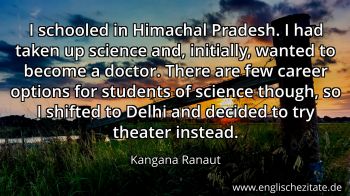
I schooled in Himachal Pradesh. I had taken up science and, initially, wanted to become a doctor. There are few career options for students of science though, so I shifted to Delhi and decided to try theater instead.
As a journalist, you have to have multiple sources and verifiable science, and when you've done that and satisfied the most skeptical voice in your head, you have an obligation to ride through the streets - let people know what's going on.