Zitat des Tages über Ökosysteme / Ecosystems:
When we settled our country, the dark forest was considered in some ways evil and something that you needed to plow or, later, bulldoze. We now have a new understanding of the interconnectedness of ecosystems and the need for bird flyways and why all species matter.
Water is the foundation for our economies, communities, ecosystems, and quality of life.
We don't need a War on Carbon. We need a new prosperity that can be shared by all while still respecting a multitude of real ecological limits - not just atmospheric gas concentrations, but topsoil depth, water supplies, toxic chemical concentrations, and the health of ecosystems, including the diversity of life they depend upon.
Seasonally ploughing and harvesting crops will mash up a few moles, slice through a burrow of field mice and crush any ground-nesting bird chicks. Far more significant, however, is the creation of the field in the first place: an act that replaces entire ecosystems, along with all their animal inhabitants.
We have reached a new milestone as a human family. With seven billion of us now inhabiting our planet, it is time to ask some fundamental questions. How can we provide a dignified life for ourselves and future generations while preserving and protecting the global commons - the atmosphere, the oceans and the ecosystems that support us?
We struggle with this every single day - will third-party apps have room in the future of ecosystems?
I love all of the ecosystems - mountains, deserts, rainforests. They're beautiful, and nature has so many different flavors to it.
Nature is good at connectivity. The impact of diverse human activities is observed and absorbed throughout nature. Everything is linked. Nature has no problem with coherence. Ecosystems react with their own logic.
No phenomenon can be isolated, but has repercussions through every aspect of our lives. We are learning that we are a fundamental part of nature's ecosystems.
The Biblical world view sees Earth and its ecosystems as the effect of a wise God's creation and... therefore robust, resilient, and self-regulating, like the product of any good engineer.
We have the capacity to create a remarkably different economy: one that can restore ecosystems and protect the environment while bringing forth innovation, prosperity, meaningful work, and true security.
Economies are embedded inside ecosystems. Companies dependent on tourism, for example, are affected by low rainfall - there's less snow for skiers, and forest fires are more intense.
Humans have changed ecosystems more rapidly and extensively than in any comparable period of time in human history, largely to meet rapidly growing demands for food, fresh water, timber, fiber and fuel. This has resulted in a substantial and largely irreversible loss in the diversity of life on Earth.
The G8 nations, together with the five major emerging economies of China, India, South Africa, Brazil, Mexico, use almost three-quarters of the Earth's biocapacity - the capacity of the world's ecosystems to produce natural resources and to reduce harmful substances.
It's the poorer people in tropical zones who will get really hit by climate change - as well as some ecosystems, which nobody wants to see disappear.
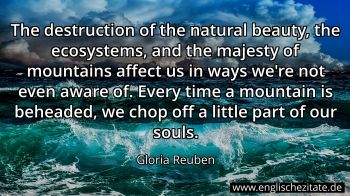
The destruction of the natural beauty, the ecosystems, and the majesty of mountains affect us in ways we're not even aware of. Every time a mountain is beheaded, we chop off a little part of our souls.
Mycologists are few and far between. We are under-funded, poorly represented in the context of other sciences - ironic, as the very foundation of our ecosystems are directly dependent upon fungi, which ultimately create the foundation of soils.