Zitat des Tages über Körpersprache / Body Language:
Naturally, my body language changes given whatever environment I'm in.
Body language is essential for an actress, even if you don't use your body in an athletic way. Just to be free, to use it like your voice. A body can be small and have incredible violence. A body talks.
When you're on set all day, and you don't look people in the eye, it's really relaxing. Normally when you talk to someone, a lot of the conversation is in the body language and in the eye contact and stuff. And if you don't do that, if you just listen to the words, it's quite relaxing, because there's just one thing to focus on.
I think reading a room - reading the personalities, reading body language - is kind of a lost art.
There's always so much more that can be conveyed on screen visually in the expressions of people's faces, in their bodies, in their body language. And also with sound design, with music.
And I have to work so hard at talking positively to myself. If I don't, it's just real hard to get through the day, and I'll get really down, and just want to cry. My whole body language changes. I get more slumped over.
I have three tools at my disposal - my whistle, my body language and my talk. It is a question of how I marry them up to try to get the players around to my way of thinking.
Never ask a woman if you may kiss her. Instead, learn to read body language.
The process of filmmaking is very musical, you get into the rhythm and the rhythmics of how someone is, especially with Woody Allen who is very much into body language and body movement.
It feels wonderful to be go back to the 1940s and recreate the whole era through my clothes, voice and body language. I am tired of playing the larger-than-life hero.
You always try to play it off cool, but even if I think I have a certain laidback body language when I'm meeting someone who I greatly admire, I still have this horrible tendency to go bright red.
When preparing a role, I work first on the body language and physical aspects of the performance; the psychological dimension comes naturally once I'm in character.
A shoe is not only a design, but it's a part of your body language, the way you walk. The way you're going to move is quite dictated by your shoes.
You have to think an awful lot about your motivations or people's behavioral intentions or what their body language can indicate or what's really going on or what makes people sometimes do, sometimes, the irrational things they do.
In this respect I suppose I'm the total opposite of Garry. With his very emotive body language at the board he shows and displays all his emotions. I don't.
I see tendencies, I see body language.
I know, for me, that I have always been very conscious of how I dress when I go to the studio, I'm very conscious of my body language when I'm working - a lot of times, I'm the only female in the room. It's a very male-dominated profession. I'm always around guys. Guys are going to try you all day, and they're going to flirt all day.
I had never really done voice-over. If you've ever seen me, I'm more the communicator through body language and movement... I'm a physical actor.
I come from a place where everything about me, even my body language, is saying: I mean you no harm. I smile, I laugh. Basic stuff for most people.
What I really like doing is storytelling, finding the body language that is necessary for the story. And when I'm doing it and it's working, I'm thrilled.
A stylist understands our body language; they know what works and what doesn't. I'm happy this concept has caught on in the South film industry.
People need realness, reality. People can sense when someone is being pretentious or fake. It's because you feel it; you see it in someone's body language.
The next time you need to win someone over to your way of thinking, try nodding your head as you speak. People unconsciously mirror the body language of those around them in order to better understand what other people are feeling.
Although our body language governs the way other people perceive us, our body language also governs how we perceive ourselves and how those perceptions become reinforced through our own behavior, our interactions, and even our physiology.
For me, actors have to have a character, an aura, body language. They're not models. They used to call actors models. But I want them to participate in the film.
We're losing social skills, the human interaction skills, how to read a person's mood, to read their body language, how to be patient until the moment is right to make or press a point. Too much exclusive use of electronic information dehumanises what is a very, very important part of community life and living together.
Before you get into the mind, you have to inhabit the physicality. Body language is a great way of speaking.
Language is a more recent technology. Your body language, your eyes, your energy will come through to your audience before you even start speaking.
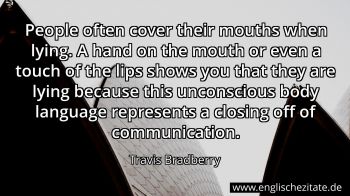
People often cover their mouths when lying. A hand on the mouth or even a touch of the lips shows you that they are lying because this unconscious body language represents a closing off of communication.
I met my grandfather just before he died, and it was the first time that I had seen Dad with a relative of his. It was interesting to see my own father as a son and the body language and alteration in attitude that comes with that, and it sort of changed our relationship for the better.